
How to Stop Overthinking and Take Action (Even When You Feel Stuck)
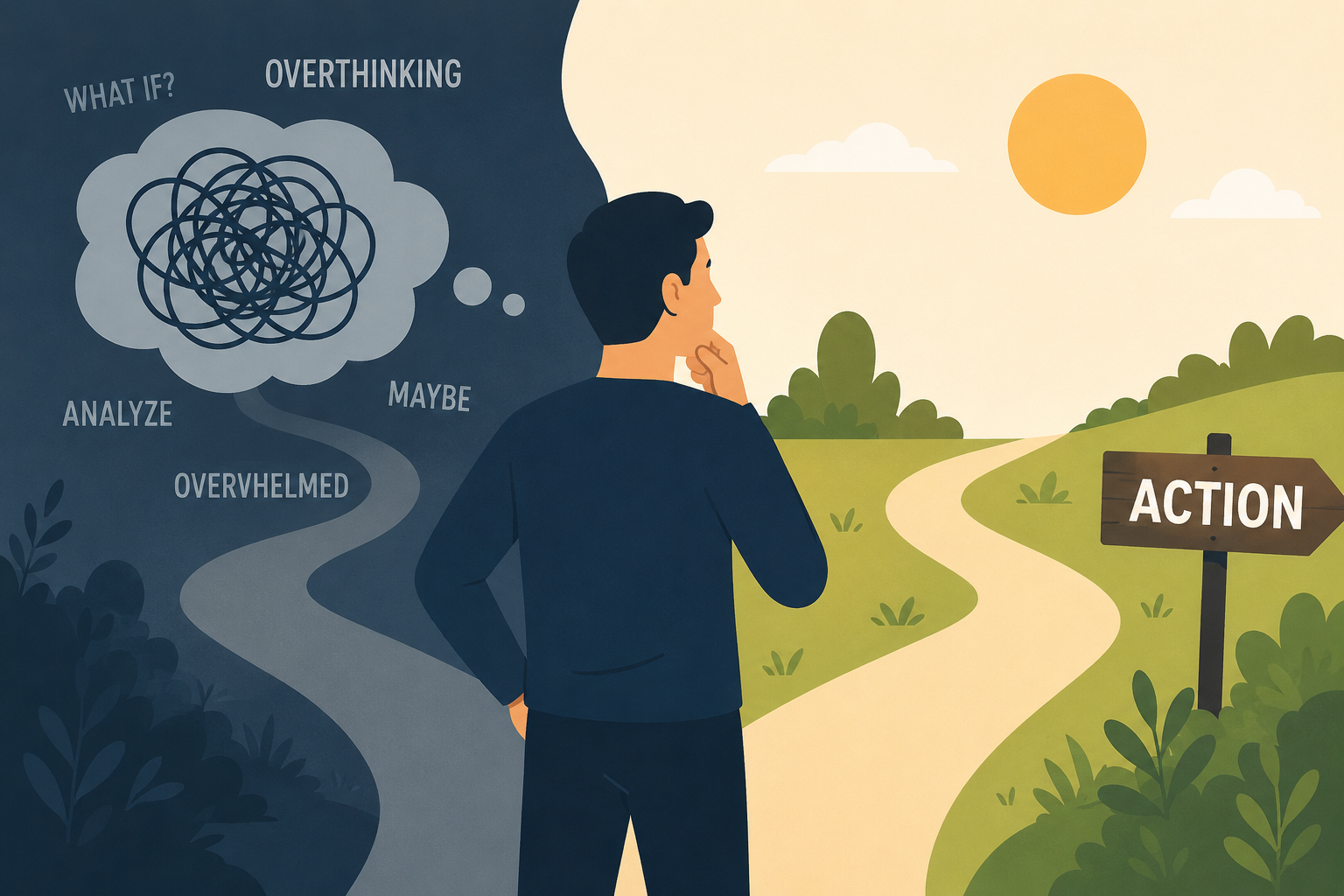
Flat illustration of a person at a crossroads, contrasting dark overthinking with a bright path of action and forward movement.
I once worked with a client who understood everything.
He could explain his problems in detail.
He saw the patterns in his relationships.
He knew exactly what he needed to do next.
But he didn’t move.
Session after session, he stayed in the same place—analyzing, reflecting, going deeper… but never acting. He lived in what I call inactive awareness: seeing clearly, but staying stuck. Comfortable in the complaint, without taking responsibility for change.
And that’s where many people get trapped.
Not because they don’t know what to do.
But because they stay in their head instead of stepping into action.
Coaching, at its core, is not about understanding more.
It’s about doing something with that understanding.
Because that’s where real change happens.
In this post, you’ll learn how to break that loop and start moving forward—even if part of you would rather stay where it is.
What is Overthinking and Why Does it Matter?
Overthinking is simple: it’s when you stay in your head instead of moving in your life.
It looks like analyzing the same situation again and again.
It sounds like “I know what I should do, but…”
It feels like being stuck between clarity and action.
And that’s the dangerous part.
Because when you understand your situation, it feels like progress.
But it’s not.
You can spend months—or years—understanding yourself better, without changing anything.
That creates a subtle kind of frustration. You know more, but your life doesn’t move. You become aware… but not free.
Here’s the shift:
Overthinking is not about thinking too much.
It’s about avoiding action.
And once you see that, you can start doing something about it.
How to Stop Overthinking and Take Action
Step 1: Notice When You’re Hiding in Awareness
There’s a moment where thinking stops being useful.
You’ve already reflected.
You’ve already understood.
You already know what to do.
But instead of acting, you go back into analysis.
That’s not growth. That’s avoidance.
Ask yourself honestly:
“Do I need more clarity… or am I delaying action?”
That question alone can wake you up.
Step 2: Accept That Knowing Is Not Enough
This is where many people get stuck—including that client.
He believed that understanding his situation would eventually lead to change.
But it doesn’t work like that.
You don’t change by knowing more.
You change by doing something different.
There’s a gap between awareness and transformation.
And that gap is filled with action.
Step 3: Lower the Bar for Action
One reason people don’t act is because they make the step too big.
So it feels heavy. Uncomfortable. Risky.
And the mind goes back to thinking.
The solution is simple: make the action smaller.
Not “fix the whole relationship.”
Just start one honest conversation.
Not “change your entire routine.”
Just take one different step today.
Action doesn’t need to be big.
It just needs to be real.
Step 4: Interrupt the Comfort of Inaction
Here’s something important:
Staying stuck is often comfortable.
You get to complain without changing.
You get to analyze without risking.
You get to stay in control without moving forward.
That’s why people stay there.
If you want to change, you need to interrupt that comfort.
Set a clear moment to act.
Create a small commitment.
Put yourself in a position where action is the only option.
Because without that interruption, your mind will always choose the familiar.
Step 5: Let Go of the Need to Be Right
Many people don’t act because they want certainty.
They want to know it will work.
They want to avoid mistakes.
They want to get it right.
But life doesn’t give you that guarantee.
That client I mentioned? He knew exactly what to do—but he didn’t trust himself enough to do it imperfectly.
So he stayed stuck.
The shift is this:
You don’t need to be right.
You need to move.
Mistakes are part of the process.
And they only happen when you act.
Step 6: Remember That Action Is Where Learning Happens
This is one of the foundations of coaching.
You don’t learn by thinking.
You learn by doing.
You act.
You see what happens.
You adjust.
That’s growth.
That’s why no amount of reflection can replace a single step forward.
Clarity doesn’t come before action.
It comes from it.
Tips and Reminders for Breaking Overthinking
You don’t need another insight—you need a step.
Awareness without action becomes frustration.
Momentum is created through movement, not thought.
You don’t have to change everything—just stop staying still.
Closing
That client eventually moved forward.
Not because he understood more.
But because he finally decided to act.
And everything started to shift from there.
You might already be in that same place—clear, aware, but stuck.
If that’s the case, the next step is not more thinking.
It’s action.
Because the difference between where you are and where you want to be is not knowledge.
It’s movement.
So take one step.
Not tomorrow. Not later.
Now.
Call-to-Action
If you’re ready to stop analyzing your life and start changing it, this is exactly the work we can do together. You don’t need more clarity—you need support to act on what you already know.