
How to Stop Overthinking and Take Action (Even When You Feel Stuck)
Overthinking feels like progress—but it often keeps you stuck. In this post, you’ll learn how to break the cycle, take action, and finally move forward.
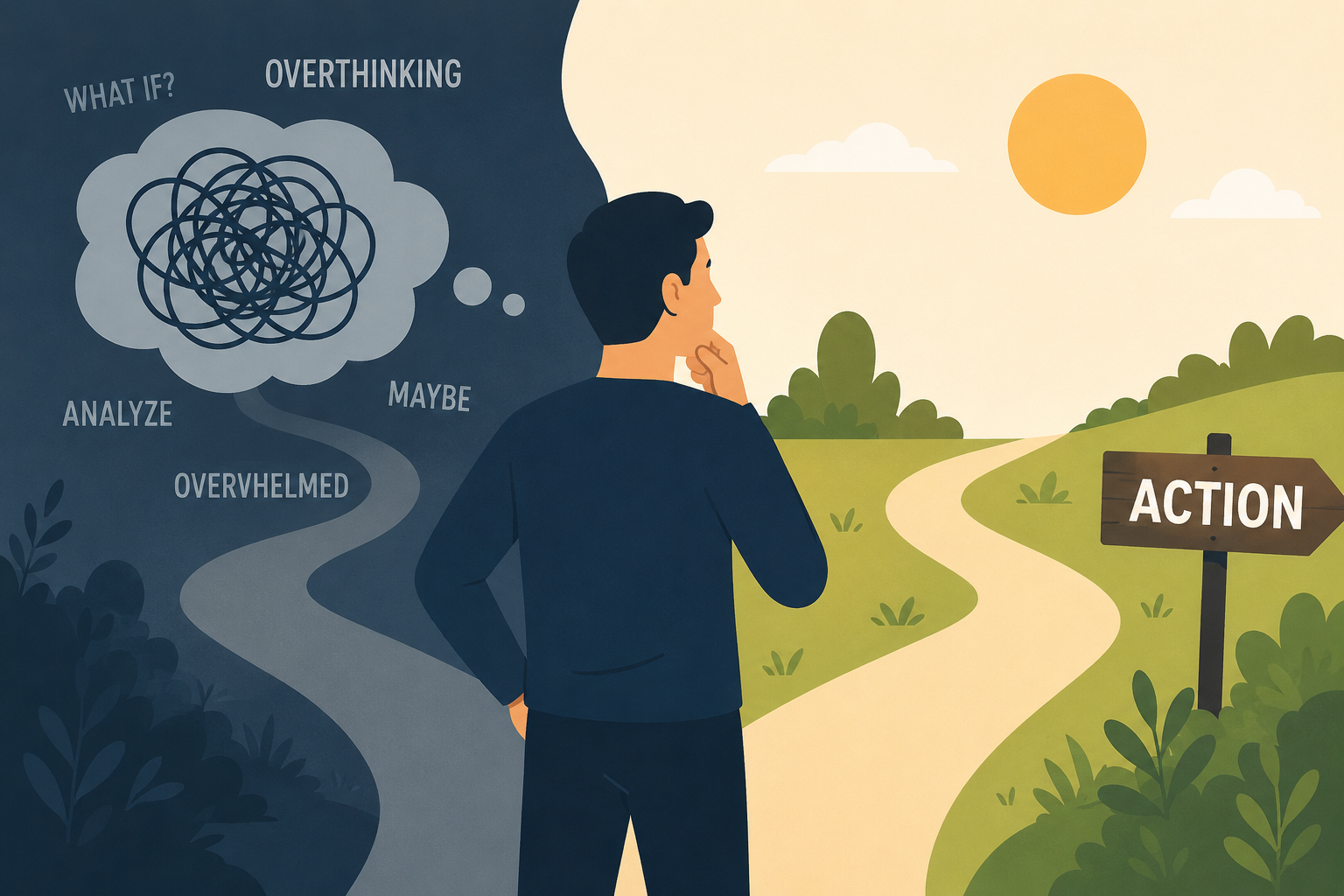
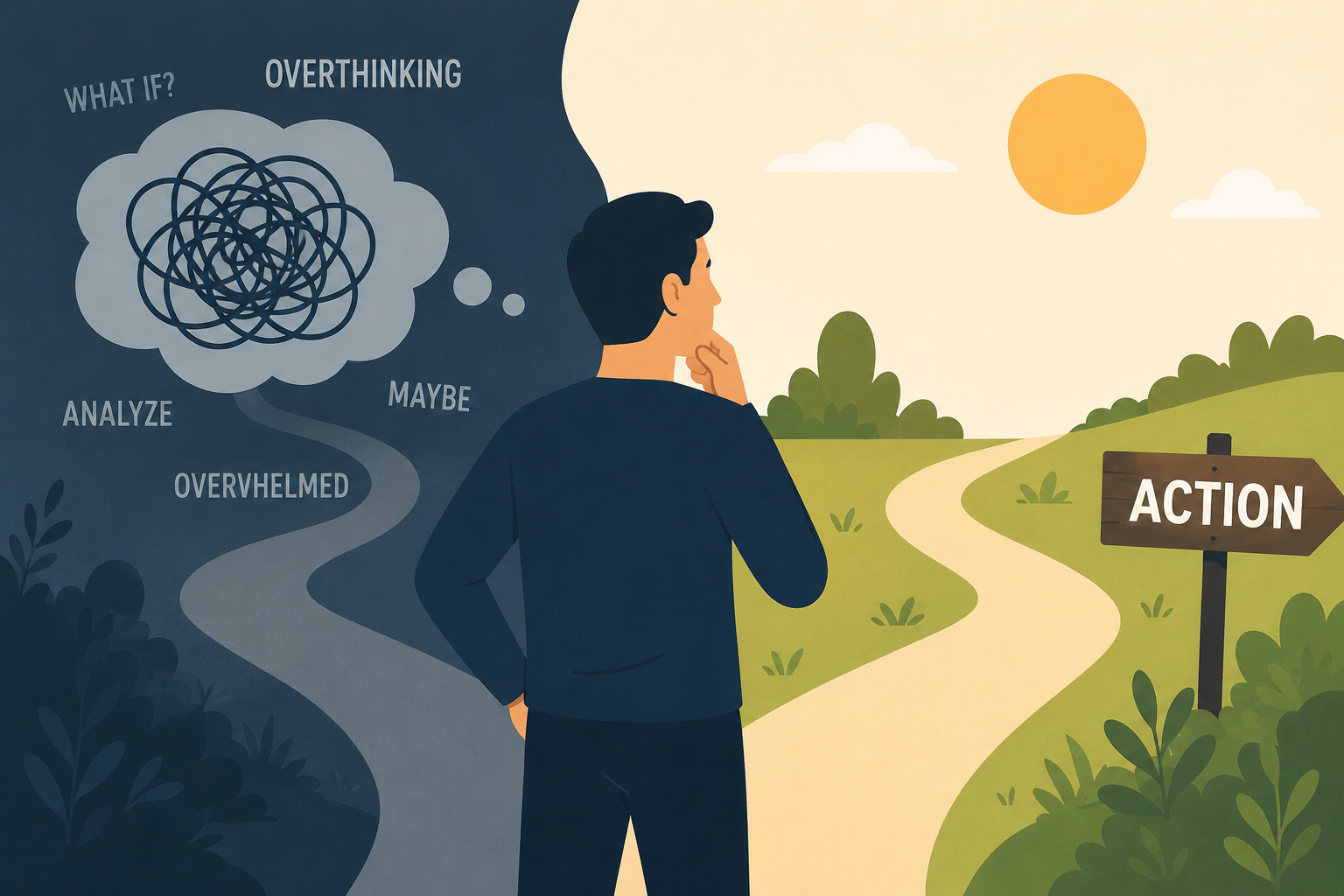
Flat illustration of a person at a crossroads, contrasting dark overthinking with a bright path of action and forward movement.
I once worked with a client who understood everything.
He could explain his problems in detail.
He saw the patterns in his relationships.
He knew exactly what he needed to do next.
But he didn’t move.
Session after session, he stayed in the same place—analyzing, reflecting, going deeper… but never acting. He lived in what I call inactive awareness: seeing clearly, but staying stuck. Comfortable in the complaint, without taking responsibility for change.
And that’s where many people get trapped.
Not because they don’t know what to do.
But because they stay in their head instead of stepping into action.
Coaching, at its core, is not about understanding more.
It’s about doing something with that understanding.
Because that’s where real change happens.
In this post, you’ll learn how to break that loop and start moving forward—even if part of you would rather stay where it is.
What is Overthinking and Why Does it Matter?
Overthinking is simple: it’s when you stay in your head instead of moving in your life.
It looks like analyzing the same situation again and again.
It sounds like “I know what I should do, but…”
It feels like being stuck between clarity and action.
And that’s the dangerous part.
Because when you understand your situation, it feels like progress.
But it’s not.
You can spend months—or years—understanding yourself better, without changing anything.
That creates a subtle kind of frustration. You know more, but your life doesn’t move. You become aware… but not free.
Here’s the shift:
Overthinking is not about thinking too much.
It’s about avoiding action.
And once you see that, you can start doing something about it.
How to Stop Overthinking and Take Action
Step 1: Notice When You’re Hiding in Awareness
There’s a moment where thinking stops being useful.
You’ve already reflected.
You’ve already understood.
You already know what to do.
But instead of acting, you go back into analysis.
That’s not growth. That’s avoidance.
Ask yourself honestly:
“Do I need more clarity… or am I delaying action?”
That question alone can wake you up.
Step 2: Accept That Knowing Is Not Enough
This is where many people get stuck—including that client.
He believed that understanding his situation would eventually lead to change.
But it doesn’t work like that.
You don’t change by knowing more.
You change by doing something different.
There’s a gap between awareness and transformation.
And that gap is filled with action.
Step 3: Lower the Bar for Action
One reason people don’t act is because they make the step too big.
So it feels heavy. Uncomfortable. Risky.
And the mind goes back to thinking.
The solution is simple: make the action smaller.
Not “fix the whole relationship.”
Just start one honest conversation.
Not “change your entire routine.”
Just take one different step today.
Action doesn’t need to be big.
It just needs to be real.
Step 4: Interrupt the Comfort of Inaction
Here’s something important:
Staying stuck is often comfortable.
You get to complain without changing.
You get to analyze without risking.
You get to stay in control without moving forward.
That’s why people stay there.
If you want to change, you need to interrupt that comfort.
Set a clear moment to act.
Create a small commitment.
Put yourself in a position where action is the only option.
Because without that interruption, your mind will always choose the familiar.
Step 5: Let Go of the Need to Be Right
Many people don’t act because they want certainty.
They want to know it will work.
They want to avoid mistakes.
They want to get it right.
But life doesn’t give you that guarantee.
That client I mentioned? He knew exactly what to do—but he didn’t trust himself enough to do it imperfectly.
So he stayed stuck.
The shift is this:
You don’t need to be right.
You need to move.
Mistakes are part of the process.
And they only happen when you act.
Step 6: Remember That Action Is Where Learning Happens
This is one of the foundations of coaching.
You don’t learn by thinking.
You learn by doing.
You act.
You see what happens.
You adjust.
That’s growth.
That’s why no amount of reflection can replace a single step forward.
Clarity doesn’t come before action.
It comes from it.
Tips and Reminders for Breaking Overthinking
You don’t need another insight—you need a step.
Awareness without action becomes frustration.
Momentum is created through movement, not thought.
You don’t have to change everything—just stop staying still.
Closing
That client eventually moved forward.
Not because he understood more.
But because he finally decided to act.
And everything started to shift from there.
You might already be in that same place—clear, aware, but stuck.
If that’s the case, the next step is not more thinking.
It’s action.
Because the difference between where you are and where you want to be is not knowledge.
It’s movement.
So take one step.
Not tomorrow. Not later.
Now.
Call-to-Action
If you’re ready to stop analyzing your life and start changing it, this is exactly the work we can do together. You don’t need more clarity—you need support to act on what you already know.
Coaching for difficult conversations
Coaching helps professionals prepare for difficult conversations with clarity, emotional awareness, and confidence. By exploring intentions, managing emotions, and practicing key communication skills, coaching turns challenging conversations into opportunities for growth, trust, and stronger relationships.
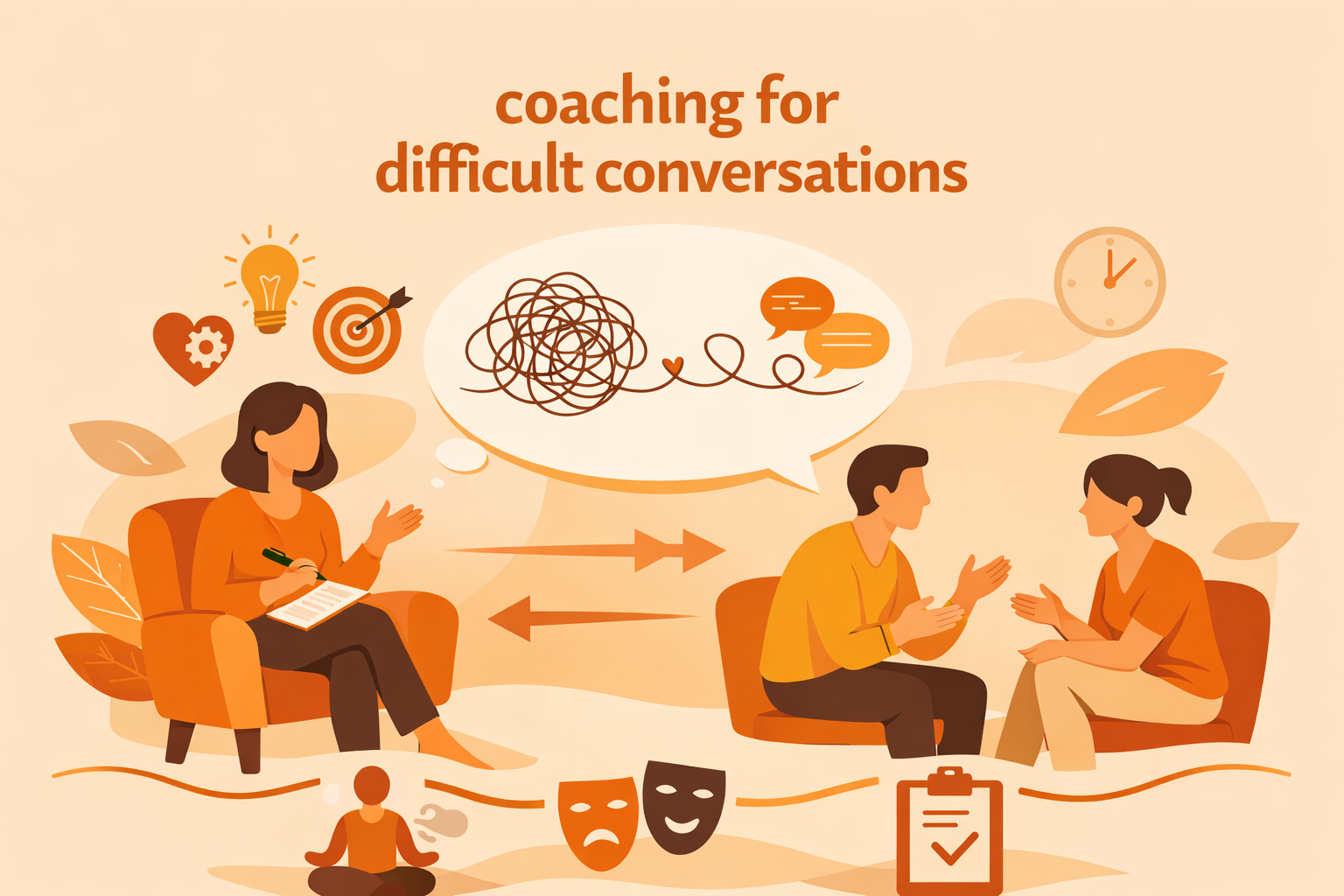
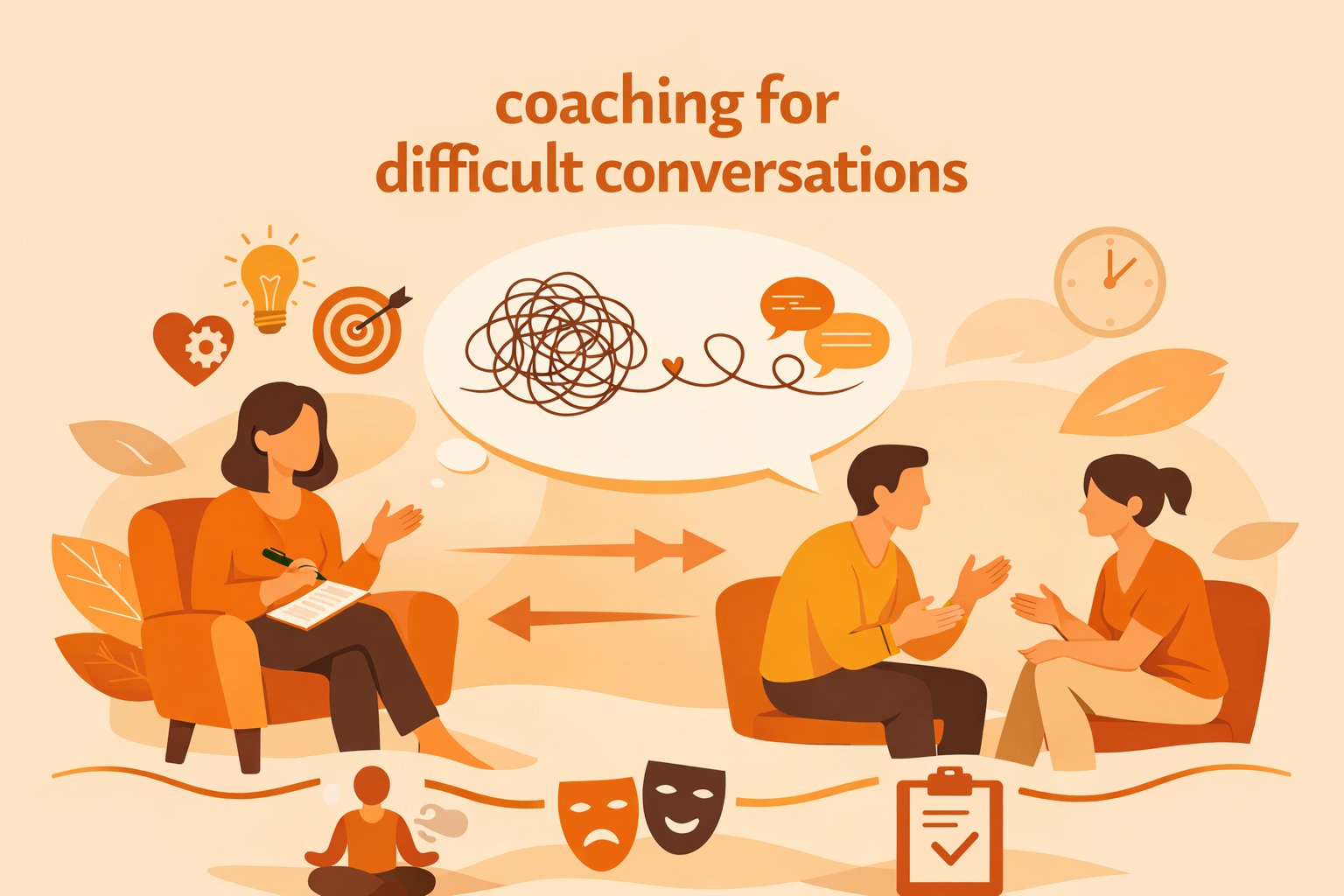
Flat-style illustration in warm tones showing a coaching session that supports people in having difficult conversations, moving from confusion to clarity.
How Coaching Helps You Prepare for Difficult Conversations
Difficult conversations are one of the most common challenges we face — at work, at home and in leadership. They can stir anxiety, trigger avoidance, or leave us feeling uncertain about the impact of our words. Yet, these conversations are often essential: they clarify expectations, strengthen relationships, and unlock growth that otherwise stays dormant. With coaching, you don’t just prepare for these conversations — you transform how you show up in them.
Why Difficult Conversations Matter
Whether it’s giving constructive feedback, addressing a conflict, or speaking up about something that truly matters, difficult conversations carry emotional weight. Most of us rehearse them in our heads, imagining worst-case scenarios and rehearsing defensive responses. That inner rehearsal rarely prepares us well. It can even deepen anxiety and delay action. With coaching, preparation shifts from anxious projection to intentional readiness.
Coaching as a Space for Clarity
At its core, coaching creates a structured space to explore your thoughts, fears, and intentions. Instead of being driven by impulse or assumption, you gain clarity about what you want to communicate and why. You begin to distinguish between emotions that distract and intentions that guide. A coach helps you articulate your real goals for the conversation: what outcome matters most, what boundaries you need to hold, and what fears are getting in the way.
This clarity is not about rehearsing a script — it’s about understanding your internal landscape so you can engage authentically. When you know what matters to you and why, your communication becomes intentional and grounded rather than reactive.
Building Emotional Awareness and Regulation
One of the hidden challenges in difficult conversations is emotional activation: stress, fear, or frustration can hijack your words if you’re not prepared. With coaching, you don’t just talk about emotions — you learn to recognize and regulate them. Through reflection and guided questions, you deepen emotional intelligence — the ability to observe your own triggers and responses.
This emotional awareness becomes a tool, not a hindrance. You become more capable of staying present, listening deeply, and responding rather than reacting — which creates space for meaningful dialogue instead of conflict escalation.
Practicing Before the Moment
Real preparation isn’t just about planning what to say — it’s about practicing how to stay aligned with your intention in the moment. Many coaching practices include role-playing or simulating parts of the conversation ahead of time. This isn’t rehearsal for perfection; it’s rehearsal for confidence. You try different approaches, explore what feels authentic, and notice where your reactions might lead you off track.
With each iteration, your nervous system becomes familiar with the emotional texture of the conversation. When the real moment arrives, there’s less fear of the unknown and more resilience to navigate unexpected turns.
A Coaching Lens for the Conversation Itself
Coaching doesn’t drop off once the conversation begins. The tools you build extend into the conversation: active listening, empathetic inquiry, and powerful questions aren’t just for coaching sessions — they are communication skills that deepen connection and reduce defensiveness.
For instance, instead of launching into your point, you might begin with:
“Help me understand how you see this situation.”
This simple shift invites the other person in, making the conversation a shared exploration rather than a confrontation.
After the Conversation: Reflection and Learning
The work doesn’t end when the conversation ends. Coaching encourages a reflective process where you explore what happened, what you learned, and what you might do differently next time. This reflection strengthens your ability for future conversations and turns each difficult interaction into a learning moment.
It’s not uncommon to walk away from a coaching-prepared conversation feeling more confident and more connected — not because you controlled the outcome, but because you showed up with clarity, intention, and presence.
Final Thought: Growth Through Courage, Not Avoidance
Difficult conversations will always be challenging — and that’s precisely why they are opportunities for growth. With coaching, you don’t collapse under pressure or rely on avoidance. You step into conversations with awareness, emotional regulation, and a clear sense of purpose. And as you practice this, difficult conversations become less threatening and more transformative — for you and for those you engage with.